
Where C-SPAN is the local TV news
|
|
| The Washington Canard Where C-SPAN is the local TV news |
|
|
Tuesday, March 01, 2005
FOR THE SAKE OF ARGUMENT While I believe I have previously made clear my intent to avoid partisan political considerations on this weblog, it so happens that I have been provoked by Frank, AKA Defcon1, AKA the man responsible for Non-Fat Latte Liberal. And so I must respond. Bear with me, or skip this post and come back later, when I'll return to blogging about neighborhood chemical contamination and encounters with people famous only to those of us who watch C-SPAN. Ahem. Frank argues that he would never vote Republican because George W. Bush "betrays the conservative values" that put him into office, and furthermore that this is a "lasting shift, not an aberration." This is rather amusing, because Frank is a "Liberal," even if a rather moderate one. Since when is he a defender of conservative values?  Anyway, let's dispense with his arguments, such as they are: Complaints that George W. Bush is not a conservative boil to two claims: 1) his foreign policy is ambitious, interventionist, and promotes freedom for others above certain national interests, and 2) he is fiscally reckless, increasing the size of government while running up large deficits. Both are in error because they are based on too-narrow definitions of conservatism. Anyway, let's dispense with his arguments, such as they are: Complaints that George W. Bush is not a conservative boil to two claims: 1) his foreign policy is ambitious, interventionist, and promotes freedom for others above certain national interests, and 2) he is fiscally reckless, increasing the size of government while running up large deficits. Both are in error because they are based on too-narrow definitions of conservatism.On the first point (on which Frank probably does not disagree greatly with me) 9/11 changed a lot. Maybe not "everything," but close enough. Many foreign policy "realists" and not a few isolationists reappraised their approach to foreign policy. I was one; at the time I was essentially a libertarian anti-interventionist. When supporting Bush in 2000, I frequently pointed to his position against using U.S. troops for nation-building. Plenty of liberals and not a few libertarians see an insurmountable conflict between promoting freedom abroad and defending national interests, but 9/11 helped me to reconsider, as it surely did George Bush, that it is in our interest to promote freedom. The left talks about the "root causes" of terrorism, but the U.S. military is actually out there uprooting those causes. On the second point ... well, look: You will never catch me defending Bush's farm bill, his steel tariffs, his deficits, or his general philosophy on government. But there exists a strain of conservatism that argues government can be used to further conservative ends, and that seems to describe George W. Bush. Before "neocon" became synonymous with "warmonger" (circa 2002) this was largely a neoconservative position, often espoused by writers at the Weekly Standard. David Brooks called it "national greatness" conservatism, claiming the U.S. is a great country, and great countries do great things. Great things (wars of liberation, trips to Mars) tend to cost a lot. I remain a small-government conservative, but I do believe big-government conservatism is legitimately conservative. Moreover, Frank leaves aside entirely the question of whether Democrats would be any better on matters of fiscal responsibility. Certainly, Democrats have enjoyed the rhetorical high road during the last few years on . Some have argued that the Democratic party is now the party of fiscal conservatism. But Democrats haven't had to prove their fiscal restraint, because they haven't had access to the federal credit cards in several years. 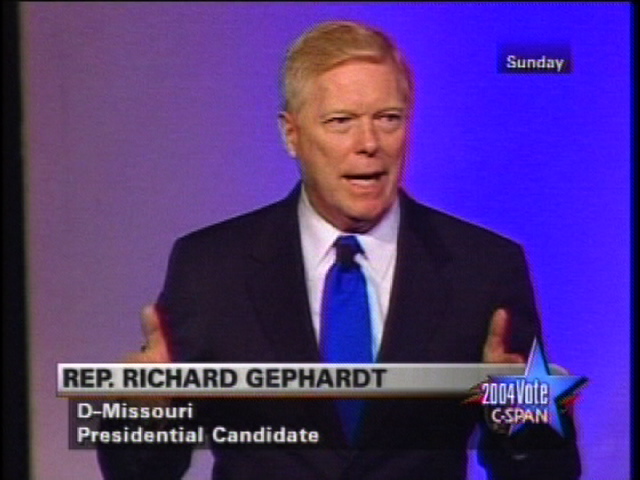 We can, however, look back to 2003 when every Democratic presidential contender was proposing massive and massively expensive taxpayer-funded health care plans. Dick Gephardt was first out of the gate with a proposal that would have cost $700 billion. Kerry wanted to spend $290 billion. Bush offered a plan that cost $100 billion. That same year, Democrats criticized Bush's Medicare prescription drug package. But the complaint was not that it cost too much, but that he had stolen their idea. (Not unlike how Bill Clinton stole welfare reform, which we'll get to soon enough.) We can, however, look back to 2003 when every Democratic presidential contender was proposing massive and massively expensive taxpayer-funded health care plans. Dick Gephardt was first out of the gate with a proposal that would have cost $700 billion. Kerry wanted to spend $290 billion. Bush offered a plan that cost $100 billion. That same year, Democrats criticized Bush's Medicare prescription drug package. But the complaint was not that it cost too much, but that he had stolen their idea. (Not unlike how Bill Clinton stole welfare reform, which we'll get to soon enough.)Now to the point that Bush's big-government ways represent a "lasting shift" among conservatives. I don't buy it, and not just because Frank doesn't make a coherent argument. He says that Bush "isn't backing down" from his big-spending ways, but he has backed off on a few things, such as the steel tariffs. Frank also seems to expect that Bush would cut back on the prescription drug bill, but after spending so much "political capital" to get it passed, that's an odd thing to think. And has he already forgotten Bush's recommended budget for next year, which freezes non-discretionary spending? (It won't get passed, but it's nice to know the president cares.) And so Frank declares: It's clear to me that the right is frantically searching for more big government Bush style conservatives. That's why there's so much talk about Condi 2008 with a field already crowded with what Goldwater would call dream candidates.This makes no sense at all. A "frantic" search for more big-spenders? On what evidence? I don't think we know precisely what Condoleezza Rice's views are just yet. As Secretary of State we may well get to see her views a bit more, but probably not on fiscal matters. Meanwhile, how a GOP field of fiscal conservatives means the end of fiscal conservatism makes no sense. And more: McCain? Not a snowball chance in hell, too conservative.  If all he's getting at is that McCain is a fiscal conservative, then I won't really disagree. McCain made my day a few years back when he berated his colleagues for "spending money like a drunken sailor." If all he's getting at is that McCain is a fiscal conservative, then I won't really disagree. McCain made my day a few years back when he berated his colleagues for "spending money like a drunken sailor." While it would probably be wrong to call him a liberal per se, McCain is at least very, very moderate. McCain is largely responsible for the spectacularly wrongheaded campaign finance "reform" of a few years ago (which Bush regrettably signed, out of has advocated higher taxes on tobacco products, and more. McCain is only a conservative on foreign policy. He was for invading Iraq before George Bush, and come to think of it the Weekly Standard was quite infatuated with him. But the Weekly Standard represents just one of several competing philosophies within the conservative movement. At this year's CPAC meeting here in Washington, the fiscal conservatives were especially vocal about Bush's deficiencies on this point. In recent elections, conservatives have stayed home when they didn't like the candidate. That's how his father lost in 1992, and the same phenomenon hurt Bob Dole in 1996. But this year, many people didn't trust John Kerry on terrorism. He never demonstrated that he "got" the war. Having nothing to say about the defining issue of the day, he kept talking about Vietnem. Had there been no war against Islamic terrorism to consider during the past election cycle, I believe many Republicans would have registered protest votes. Frank would have been on more solid ground had he argued that Republicans will go along with big government so long as the Democrats remain weak on foreign policy. Even so, the fiscal conservatives aren't going anywhere. If they break away and deny another Republican the presidency, the party will correct and libertarians will probably make a comeback not unlike 1994. And he's not just wrong about conservatism — he's wrong about liberalism as well (not to mention proper capitalization): Clinton never betrayed Liberal Ideological precepts. Remember Liberalism isn't Socialism. We don't believe that larger Government is desirable as an end in itself. We don't call for a welfare state, we simply believe that government CAN help people, reforming welfare doesn't contradict our ideology anymore than private schools do.  What is he talking about? and it a The left vehemently opposes school vouchers, just as they opposed welfare reform. Most eventually got over welfare reform, especially when it worked. But it would be a mistake to forget that left-wing ideology held that removing the "safety net" of welfare would prove disastrous. Today they argue this will be the case with Social Security. Assuming it gets passed (and depending on what gets passed) I expect they will be wrong again. What is he talking about? and it a The left vehemently opposes school vouchers, just as they opposed welfare reform. Most eventually got over welfare reform, especially when it worked. But it would be a mistake to forget that left-wing ideology held that removing the "safety net" of welfare would prove disastrous. Today they argue this will be the case with Social Security. Assuming it gets passed (and depending on what gets passed) I expect they will be wrong again.Frank seems to think the DLC is the Democratic Party. But the DLC didn't get its favored candidate installed as chairman of the party. MoveOn did. Frank's argument that Bush "betrayed" conservatism calls to mind John Kerry's complaint last year that Bush was not a "real conservative." This struck me as rather disingenuous. Was Kerry arguing that Bush was the liberal, and that Kerry himself was the real conservative? Is that what I don't think Frank is being disingenuous, but I'm a little confused as to what he's getting at. I have a theory or two, but I'll wait for a response. UPDATE — To read David Brooks' 1997 essay making the case for "national greatness" conservatism, click here. |
|
|
|
|
|||||||||||||||||||||||||||||||||||
|
 |
||||||||||||||||||||||||||||||||||||||
|
|||||||||||||||||||||||||||||||||||||||


